
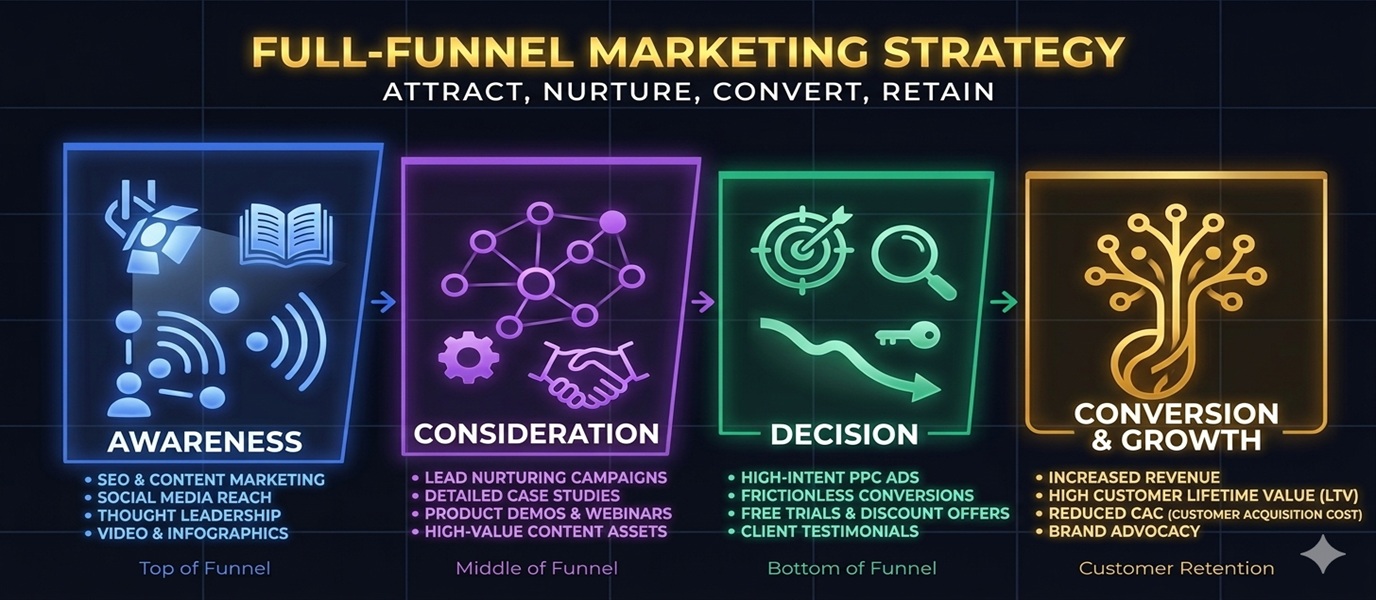
What “Full-Funnel” Actually Means (and Why Most Teams Get It Wrong)
A full-funnel marketing strategy means deliberately guiding a potential customer from the moment they first become aware of a problem all the way through to purchase — and beyond. Simple in theory. Brutally hard in practice.
The reason most teams fail at it isn’t a lack of effort. It’s a structural one: marketing teams are rewarded for top-of-funnel metrics (impressions, traffic, MQLs), while revenue accountability often lives with sales. That split creates a chasm in the middle of the funnel where deals quietly die.
A true full-funnel strategy requires three things:
- Shared definitions across marketing and sales about what “good” looks like at each stage
- Content and campaigns built for each stage, not repurposed from the top
- Measurement that connects activity to revenue, not just activity to activity
Get those three right, and everything else follows.
The Three Stages — and What Each One Actually Needs
Stage 1: Awareness (Top of Funnel)
The job of the top of funnel is not to sell. It’s to earn attention and establish credibility with people who have a problem you can solve — before they’re ready to buy.
The mistake most teams make here: Treating brand awareness as a vanity exercise, or swinging the other way and making every top-of-funnel piece of content a thinly veiled pitch. Both destroy trust.
What works:
- Educational content that addresses the problem, not the product. Blog posts, newsletters, short-form video, and podcasts that teach something genuinely useful pull in audiences with real intent.
- Thought leadership from executives and subject-matter experts. In crowded markets, distribution is a commodity — perspective is what differentiates.
- Paid reach (social and search) to amplify content to look-alike audiences and in-market segments. At this stage, the metric is quality engagement, not conversions.
Key metrics: Share of voice, organic traffic growth, content engagement rate, brand search volume over time.
Stage 2: Consideration (Middle of Funnel)
This is the most neglected and most important stage. Prospects know they have a problem. They’re evaluating options. And if you go dark on them here, a competitor fills the silence.
The middle of funnel is where most revenue is won or lost — not at the bottom.
What works:
- Comparison and “versus” content. Buyers are searching “Tool A vs Tool B” right now. If you’re not in those conversations, you don’t exist.
- Case studies and social proof tied to specific use cases, industries, or roles — not generic success stories. “How a 50-person SaaS company reduced churn by 30%” hits harder than “Customer Success Story.”
- Lead nurture sequences that progress a prospect’s understanding over time. Not drip campaigns that send the same promotional email every two weeks — sequences designed around the questions buyers actually ask before making a decision.
- Retargeting campaigns to re-engage site visitors with progressively more specific offers (demo, free trial, consultation) based on what they’ve already engaged with.
- Webinars and events that let prospects experience your thinking and expertise firsthand.
Key metrics: MQL-to-SQL conversion rate, content-assisted pipeline, time in stage, email engagement rates by sequence.
Stage 3: Decision (Bottom of Funnel)
By the time a buyer reaches the bottom of the funnel, marketing’s job shifts from educating to removing friction and reinforcing confidence. The deal can still be lost here — often to indecision rather than a competitor.
What works:
- Sales enablement assets: ROI calculators, implementation guides, security documentation, proposal templates. Anything that makes it easier for your champion to sell you internally.
- High-intent paid search: Bidding on branded terms, competitor terms, and “buy/best/top [category]” keywords. Cost-per-click is high; intent is higher.
- Free trials and demos with deliberate onboarding sequences that get the prospect to their first “aha” moment fast.
- Personalized outreach informed by marketing data — sales reaching out at the right moment (e.g., after a prospect reads your pricing page three times) with the right message.
Key metrics: SQL-to-closed-won rate, deal velocity, revenue influenced by marketing, average contract value.
Building the Engine: How to Connect the Stages
Having good content at each stage isn’t enough. You need the infrastructure to move people through the funnel deliberately.
1. Define your Ideal Customer Profile (ICP) with surgical specificity
Not “mid-market B2B SaaS companies.” That’s a market. Your ICP is the slice of that market where you win disproportionately — defined by industry, company size, tech stack, growth stage, and the specific trigger events that make them likely to buy now.
Every piece of content, every campaign, every nurture sequence should be built for that ICP. Breadth kills conversion rates.
2. Map content to buyer questions, not funnel stages
Most content calendars are organized by format or by funnel stage. A better organizing principle: the questions your buyer is asking at each point in their journey.
Interview your best customers. Talk to your sales team. Listen to sales calls. Build a question map, then build content that answers those questions better than anyone else.
3. Build a lead scoring model that actually reflects buying intent
Default lead scoring (10 points for opening an email, 5 points for visiting a page) generates noise, not signal. A better model weights behaviors that correlate with closed revenue — and that means looking backward through your CRM data to identify which actions the buyers who converted actually took.
High-value signals: Repeated visits to pricing or ROI content, attending a live demo, consuming multiple case studies in a short period, direct outreach from a company that fits your ICP.
4. Create a clear handoff protocol between marketing and sales
Define — in writing, with agreement from both sides — what constitutes a sales-qualified lead. What firmographic criteria must be met? What behavioral signals? What’s the expected follow-up time once a lead is handed off? What happens if a lead doesn’t respond?
Without this, leads fall through the cracks and blame circulates instead of revenue.
5. Build feedback loops
Marketing needs to know what happens to the leads it generates. Sales needs to know what content prospects have consumed before a call. Both teams need to be in the same conversation about what’s working and what isn’t.
A weekly pipeline review that includes marketing isn’t a luxury — it’s the connective tissue of a full-funnel operation.
The Revenue Attribution Problem
No attribution model is perfect. First-touch overstates awareness. Last-touch overstates bottom-funnel. Multi-touch attribution is more accurate but more complex, and the data is rarely clean.
The practical answer: use multiple attribution models in parallel and treat attribution as a directional tool, not a definitive one.
First-touch attribution tells you what’s driving awareness and new pipeline. Last-touch tells you what’s closing deals. The gap between the two tells you where your funnel has holes.
For most teams at an early or mid-stage of funnel maturity, a simpler approach works well: track which marketing activities appear in the history of deals that close, and double down on those. You don’t need a perfect attribution model to make good investment decisions — you need consistent data and honest analysis.
A Note on Timing: Full-Funnel Marketing Is a Long Game
It’s worth being honest about timelines. Top-of-funnel investments — SEO, brand content, thought leadership — typically take 6–12 months to compound meaningfully. If you’re under pressure to show revenue impact in Q1, the answer isn’t to abandon the top of funnel; it’s to run paid and bottom-funnel plays in parallel while the organic engine builds.
The teams that consistently win at full-funnel marketing are the ones who resist the pressure to cannibalize long-term programs for short-term metrics. They invest in brand and demand simultaneously, measure what matters at each stage, and keep marketing and sales aligned around revenue — not individual departmental scorecards.
Putting It Together: A Starting Framework
If you’re building a full-funnel strategy from scratch, here’s a practical sequence:
- Define and document your ICP. If you can’t describe your best-fit customer precisely, you can’t build a funnel for them.
- Audit your existing content against the buyer journey. What questions go unanswered? Where does the conversation go dark?
- Build one strong asset at each stage before trying to scale. A flagship guide (ToFu), two or three detailed case studies (MoFu), and an ROI calculator (BoFu) will outperform a dozen mediocre pieces at any single stage.
- Instrument your funnel. You can’t optimize what you can’t measure. Get your CRM, marketing automation, and analytics talking to each other before you scale investment.
- Establish a marketing-sales SLA. Define lead handoff criteria, response times, and shared revenue targets.
- Run a monthly or quarterly funnel review. Look at conversion rates at each stage. Find the bottleneck. Fix it. Repeat.