
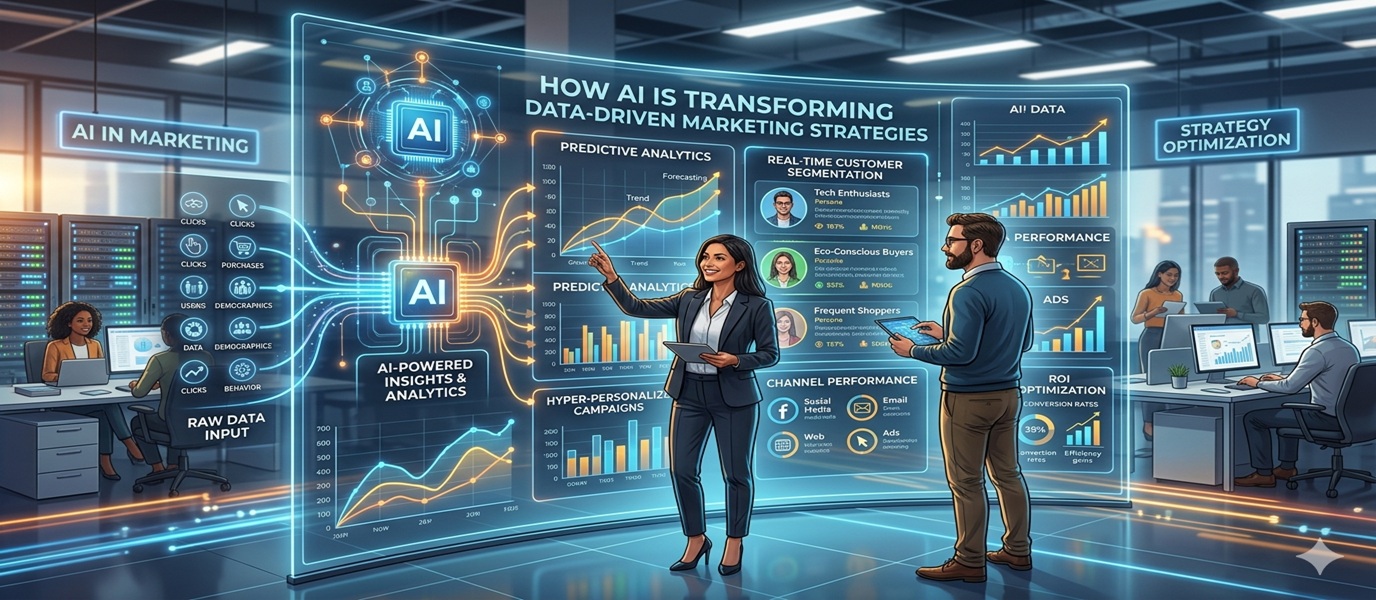
In today’s hyperconnected digital economy, marketing is no longer driven by intuition alone. Organizations now operate in an environment where every click, search, interaction, purchase, and engagement generates valuable data. The challenge is no longer collecting data—it is transforming that data into actionable insights that drive business growth. This is where Artificial Intelligence (AI) is redefining the future of marketing.
AI is not simply another technology trend; it has become a strategic enabler that empowers marketers to make faster, smarter, and more accurate decisions. From predictive analytics to hyper-personalization, AI is transforming how businesses understand customers, optimize campaigns, and maximize return on investment (ROI).
The Evolution of Data-Driven Marketing
Traditional data-driven marketing relied heavily on historical reports, manual segmentation, and retrospective analysis. Marketing teams often spent significant time collecting data from multiple sources such as CRM platforms, web analytics, social media, paid advertising channels, and email marketing tools before making strategic decisions.
While this approach provided valuable insights, it had limitations:
- Delayed decision-making
- Fragmented customer data
- Manual reporting processes
- Limited predictive capabilities
- Difficulty scaling personalization
AI addresses these limitations by enabling real-time analysis, automation, and predictive intelligence.
How AI is Revolutionizing Data-Driven Marketing
1. Predictive Analytics for Smarter Decision-Making
One of AI’s most significant contributions to marketing is predictive analytics. AI algorithms analyze historical customer behavior, purchase patterns, engagement metrics, and market trends to predict future outcomes.
Marketers can now:
- Predict which leads are most likely to convert
- Forecast customer lifetime value (CLV)
- Identify churn risks before customers leave
- Anticipate seasonal demand trends
- Optimize marketing budgets proactively
For example, an e-commerce company can use AI to predict which customers are likely to make repeat purchases and target them with personalized offers.
Business Impact:
Higher conversion rates, improved customer retention, and optimized marketing investments.
2. Hyper-Personalization at Scale
Modern customers expect personalized experiences across every touchpoint. AI makes it possible to deliver individualized content, recommendations, and messaging to millions of users simultaneously.
AI analyzes:
- Browsing behavior
- Purchase history
- Device usage
- Location data
- Content engagement patterns
- Search intent
Based on these insights, marketers can personalize:
- Website content
- Product recommendations
- Email campaigns
- Push notifications
- Social media ads
- Landing pages
Streaming platforms and online retailers have already demonstrated how AI-powered recommendations can significantly increase engagement and revenue.
Business Impact:
Improved customer experience, increased engagement, and higher revenue per customer.
3. Advanced Customer Segmentation
Traditional segmentation often relied on demographics such as age, gender, or location. AI enables much deeper segmentation by identifying behavioral and predictive patterns.
AI can automatically create micro-segments based on:
- Purchase intent
- Engagement frequency
- Content preferences
- Channel affinity
- Price sensitivity
- Lifecycle stage
This enables marketers to move from broad targeting to precision marketing.
Business Impact:
Lower customer acquisition costs and better campaign performance.
4. Real-Time Campaign Optimization
AI continuously monitors campaign performance across channels and automatically adjusts campaigns based on performance signals.
AI can optimize:
- Bid strategies in paid media
- Audience targeting
- Ad creatives
- Email send times
- Budget allocation
- Conversion pathways
Instead of waiting for weekly performance reports, marketers can respond instantly to changing market conditions.
Business Impact:
Higher ROAS (Return on Ad Spend) and reduced wasted spend.
5. Intelligent Marketing Automation
AI takes marketing automation beyond rule-based workflows.
AI-powered automation can:
- Score leads dynamically
- Trigger personalized nurture journeys
- Recommend next-best actions
- Automate content distribution
- Optimize customer communication timing
This reduces manual effort while improving campaign relevance.
Business Impact:
Greater operational efficiency and improved lead quality.
6. Conversational AI and Customer Engagement
AI-powered chatbots and virtual assistants are transforming customer interactions.
These systems can:
- Answer customer questions instantly
- Recommend products
- Capture leads
- Schedule appointments
- Resolve support issues
- Guide purchase decisions
Available 24/7, conversational AI enhances customer experience while reducing support costs.
Business Impact:
Improved customer satisfaction and faster response times.
7. Content Intelligence and Creative Optimization
AI is changing how content is created, tested, and optimized.
AI tools help marketers:
- Generate content ideas
- Write email subject lines
- Optimize SEO content
- Analyze content performance
- Predict high-performing creatives
- Test multiple content variations
This helps teams create more relevant and effective content faster.
Business Impact:
Higher engagement and faster content production cycles.
8. Attribution and Marketing Mix Modeling
One of marketing’s biggest challenges is understanding which channels truly drive conversions.
AI improves attribution by analyzing multi-touch customer journeys across:
- Search
- Social media
- Display advertising
- Organic traffic
- Direct visits
AI-powered attribution models provide a more accurate view of channel performance.
Business Impact:
Better budget allocation and improved strategic planning.
Challenges in AI Adoption
Despite its benefits, implementing AI in marketing comes with challenges:
Data Quality Issues
AI models are only as effective as the data they receive.
Data Privacy and Compliance
Organizations must comply with evolving regulations while using customer data responsibly.
Technology Integration
Integrating AI with existing CRM, analytics, and marketing platforms can be complex.
Skill Gaps
Marketing teams need analytical and AI literacy to maximize value.
Organizations that address these challenges early gain a significant competitive advantage.
The Future of AI in Marketing
The next wave of AI-driven marketing will focus on:
- Predictive customer journey orchestration
- Real-time personalization
- Voice and visual search optimization
- Autonomous campaign management
- Generative AI for content creation
- Advanced customer sentiment analysis
As AI continues to evolve, marketing will become increasingly intelligent, proactive, and customer-centric.
Conclusion
AI is fundamentally transforming data-driven marketing strategies by turning vast amounts of data into actionable intelligence. It empowers organizations to predict customer behavior, personalize experiences, automate processes, optimize campaigns, and measure impact with unprecedented precision.
For modern businesses, AI is no longer optional—it is becoming a core component of sustainable digital growth.
Organizations that successfully combine data, analytics, and AI-driven decision-making will be best positioned to lead in the competitive digital landscape of tomorrow.