
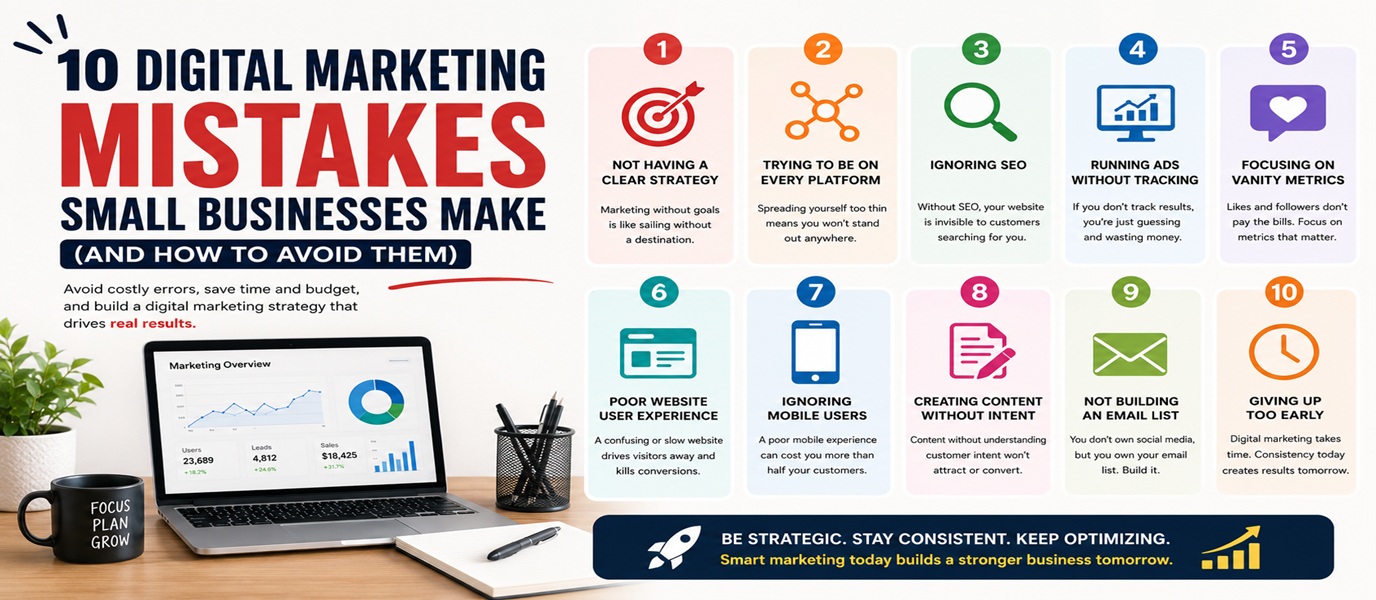
In today’s digital-first world, having a website or social media page is no longer enough. Thousands of small businesses invest in digital marketing every month—running ads, posting on social media, sending emails—but many still struggle to generate consistent leads and sales. Why? Because digital marketing is not just about being online. It’s about being strategic. The truth is, many small businesses repeat the same mistakes that drain budgets, waste time, and slow growth. In this article, we’ll explore the 10 most common digital marketing mistakes small businesses make—and how you can avoid them. 1. Not Having a Clear Marketing Strategy Many businesses jump straight into running ads or posting on social media without a roadmap. They ask: But they never ask: “What is our business goal?” Without a strategy, marketing becomes random. Common signs: How to fix it: Start with clear goals: Build a funnel that supports those goals. 2. Trying to Be on Every Platform Many small businesses believe they need to be everywhere: The result? They spread their resources too thin and fail to build momentum anywhere. How to fix it: Identify where your customers actually spend time. For example: Focus on 1–2 channels first. 3. Ignoring Search Engine Optimization (SEO) Many business owners build a website and assume customers will magically find it. That rarely happens. Without SEO, your website is invisible in search results. Common mistakes: How to fix it: Focus on: SEO is a long-term asset—not a quick hack. 4. Running Ads Without Tracking This is one of the most expensive mistakes. Businesses run campaigns on platforms like: …but don’t track: Without tracking, you’re guessing. How to fix it: Set up: Measure everything. 5. Focusing on Vanity Metrics Many businesses celebrate: But these don’t always pay the bills. What actually matters: How to fix it: Track business metrics, not ego metrics. 6. Poor Website User Experience You can drive all the traffic in the world, but if your website is confusing, visitors leave. Common UX issues: How to fix it: Ask: Can a visitor understand what we offer in 5 seconds? If not, simplify. 7. Ignoring Mobile Users More than half of digital traffic comes from mobile devices. Yet many small business websites still look terrible on smartphones. Common issues: How to fix it: Design mobile-first. Test every landing page on multiple devices. 8. Creating Content Without Understanding Customer Intent Many businesses create content they want to talk about… Instead of what customers actually search for. Example: Wrong: “About Our Company” Better: “How to Choose the Right Running Shoes” How to fix it: Understand customer journey: Create content for every stage. 9. Not Building an Email List Social media algorithms change. Ad costs rise. But email remains one of the highest ROI channels. Yet many small businesses ignore it. How to fix it: Offer something valuable: Then nurture leads through email automation. 10. Giving Up Too Early This might be the biggest mistake. Many businesses quit after: Digital marketing is not instant. It’s a system. How to fix it: Commit to: Consistency beats shortcuts. Final Thoughts Digital marketing doesn’t fail because small businesses lack tools. It fails because they lack strategy, tracking, and patience. Avoid these 10 mistakes, and you’ll build a marketing engine that generates:
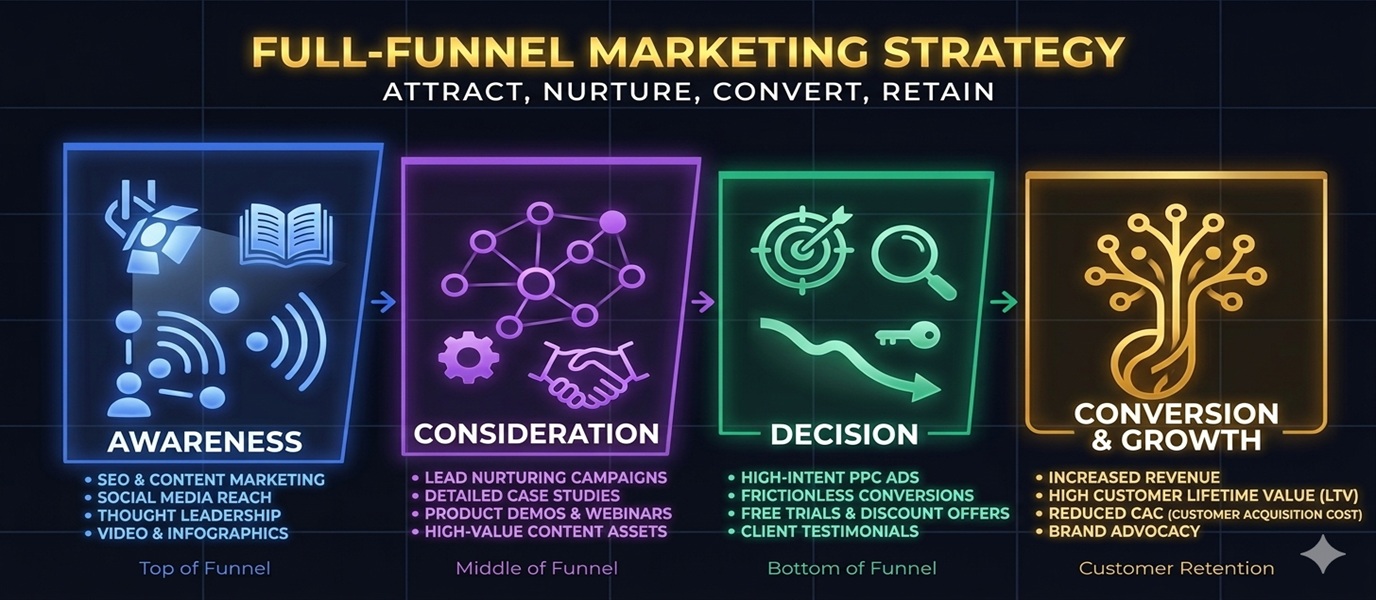
How to Build a Full-Funnel Marketing Strategy That Actually Drives Revenue
What “Full-Funnel” Actually Means (and Why Most Teams Get It Wrong) A full-funnel marketing strategy means deliberately guiding a potential customer from the moment they first become aware of a problem all the way through to purchase — and beyond. Simple in theory. Brutally hard in practice. The reason most teams fail at it isn’t a lack of effort. It’s a structural one: marketing teams are rewarded for top-of-funnel metrics (impressions, traffic, MQLs), while revenue accountability often lives with sales. That split creates a chasm in the middle of the funnel where deals quietly die. A true full-funnel strategy requires three things: Get those three right, and everything else follows. The Three Stages — and What Each One Actually Needs Stage 1: Awareness (Top of Funnel) The job of the top of funnel is not to sell. It’s to earn attention and establish credibility with people who have a problem you can solve — before they’re ready to buy. The mistake most teams make here: Treating brand awareness as a vanity exercise, or swinging the other way and making every top-of-funnel piece of content a thinly veiled pitch. Both destroy trust. What works: Key metrics: Share of voice, organic traffic growth, content engagement rate, brand search volume over time. Stage 2: Consideration (Middle of Funnel) This is the most neglected and most important stage. Prospects know they have a problem. They’re evaluating options. And if you go dark on them here, a competitor fills the silence. The middle of funnel is where most revenue is won or lost — not at the bottom. What works: Key metrics: MQL-to-SQL conversion rate, content-assisted pipeline, time in stage, email engagement rates by sequence. Stage 3: Decision (Bottom of Funnel) By the time a buyer reaches the bottom of the funnel, marketing’s job shifts from educating to removing friction and reinforcing confidence. The deal can still be lost here — often to indecision rather than a competitor. What works: Key metrics: SQL-to-closed-won rate, deal velocity, revenue influenced by marketing, average contract value. Building the Engine: How to Connect the Stages Having good content at each stage isn’t enough. You need the infrastructure to move people through the funnel deliberately. 1. Define your Ideal Customer Profile (ICP) with surgical specificity Not “mid-market B2B SaaS companies.” That’s a market. Your ICP is the slice of that market where you win disproportionately — defined by industry, company size, tech stack, growth stage, and the specific trigger events that make them likely to buy now. Every piece of content, every campaign, every nurture sequence should be built for that ICP. Breadth kills conversion rates. 2. Map content to buyer questions, not funnel stages Most content calendars are organized by format or by funnel stage. A better organizing principle: the questions your buyer is asking at each point in their journey. Interview your best customers. Talk to your sales team. Listen to sales calls. Build a question map, then build content that answers those questions better than anyone else. 3. Build a lead scoring model that actually reflects buying intent Default lead scoring (10 points for opening an email, 5 points for visiting a page) generates noise, not signal. A better model weights behaviors that correlate with closed revenue — and that means looking backward through your CRM data to identify which actions the buyers who converted actually took. High-value signals: Repeated visits to pricing or ROI content, attending a live demo, consuming multiple case studies in a short period, direct outreach from a company that fits your ICP. 4. Create a clear handoff protocol between marketing and sales Define — in writing, with agreement from both sides — what constitutes a sales-qualified lead. What firmographic criteria must be met? What behavioral signals? What’s the expected follow-up time once a lead is handed off? What happens if a lead doesn’t respond? Without this, leads fall through the cracks and blame circulates instead of revenue. 5. Build feedback loops Marketing needs to know what happens to the leads it generates. Sales needs to know what content prospects have consumed before a call. Both teams need to be in the same conversation about what’s working and what isn’t. A weekly pipeline review that includes marketing isn’t a luxury — it’s the connective tissue of a full-funnel operation. The Revenue Attribution Problem No attribution model is perfect. First-touch overstates awareness. Last-touch overstates bottom-funnel. Multi-touch attribution is more accurate but more complex, and the data is rarely clean. The practical answer: use multiple attribution models in parallel and treat attribution as a directional tool, not a definitive one. First-touch attribution tells you what’s driving awareness and new pipeline. Last-touch tells you what’s closing deals. The gap between the two tells you where your funnel has holes. For most teams at an early or mid-stage of funnel maturity, a simpler approach works well: track which marketing activities appear in the history of deals that close, and double down on those. You don’t need a perfect attribution model to make good investment decisions — you need consistent data and honest analysis. A Note on Timing: Full-Funnel Marketing Is a Long Game It’s worth being honest about timelines. Top-of-funnel investments — SEO, brand content, thought leadership — typically take 6–12 months to compound meaningfully. If you’re under pressure to show revenue impact in Q1, the answer isn’t to abandon the top of funnel; it’s to run paid and bottom-funnel plays in parallel while the organic engine builds. The teams that consistently win at full-funnel marketing are the ones who resist the pressure to cannibalize long-term programs for short-term metrics. They invest in brand and demand simultaneously, measure what matters at each stage, and keep marketing and sales aligned around revenue — not individual departmental scorecards. Putting It Together: A Starting Framework If you’re building a full-funnel strategy from scratch, here’s a practical sequence:
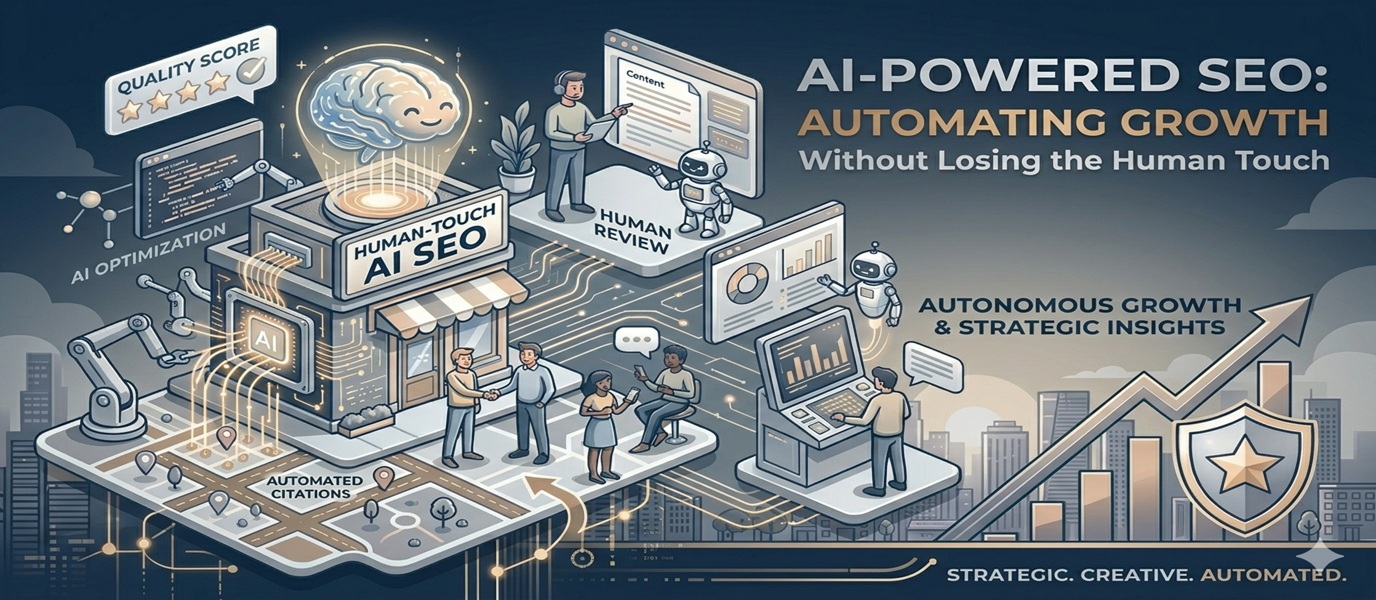
AI-Powered SEO: Automating Growth Without Losing the Human Touch
Search engine optimization has evolved dramatically over the last decade. What was once focused primarily on keywords, backlinks, and technical optimization has transformed into a sophisticated discipline driven by data, user intent, content quality, and continuous adaptation. Today, Artificial Intelligence (AI) is reshaping SEO faster than any previous technological shift. From keyword research and content optimization to predictive analytics and technical audits, AI is helping marketers automate complex processes, uncover hidden opportunities, and scale growth like never before. But with all this automation comes an important question: Can businesses leverage AI for SEO without losing the authenticity, creativity, and trust that human-driven marketing creates? The answer is yes—but only when AI is used as an amplifier of human expertise, not a replacement for it. The Evolution of SEO in the AI Era Traditional SEO often required marketers to manually: These tasks were valuable but time-consuming. AI has transformed this process by enabling real-time analysis, pattern recognition, predictive recommendations, and workflow automation. Instead of spending hours gathering data, marketers can now focus on strategy, creativity, storytelling, and customer experience. This shift is redefining how businesses approach organic growth. How AI is Transforming SEO 1. Smarter Keyword Research and Search Intent Analysis Keywords are no longer just about search volume. Search engines now prioritize intent, context, and relevance. AI can analyze millions of search queries to identify: Instead of targeting isolated keywords, marketers can build topic clusters aligned with how users actually search. Business Impact:Better rankings, higher relevance, and increased qualified traffic. 2. Content Optimization at Scale Creating SEO content manually for hundreds of pages can be challenging. AI helps marketers: This enables content teams to scale production while maintaining consistency. However, AI should support content creation—not replace human expertise, industry knowledge, or brand voice. Business Impact:Faster content production and stronger organic visibility. 3. Predictive SEO and Opportunity Forecasting One of AI’s biggest advantages is prediction. AI can forecast: This allows businesses to act before competitors. For example, a healthcare brand can identify rising search interest in a treatment topic months before peak demand. Business Impact:First-mover advantage and sustained traffic growth. 4. Technical SEO Automation Technical SEO often involves repetitive analysis. AI-powered tools can automatically detect: Instead of manually auditing hundreds or thousands of pages, teams can prioritize issues based on business impact. Business Impact:Improved site health and better search engine performance. 5. AI-Driven Content Personalization Modern SEO is increasingly tied to user experience. AI can analyze user behavior such as: Based on these insights, businesses can deliver: This improves engagement and conversion. Business Impact:Lower bounce rates and higher conversion rates. 6. Automated SERP and Competitor Intelligence Search rankings are constantly changing. AI monitors: This provides real-time competitive intelligence. Marketers can respond faster instead of waiting for monthly reports. Business Impact:Faster optimization cycles and stronger market positioning. 7. Link Building and Outreach Intelligence AI can support link-building by identifying: It can also prioritize outreach opportunities based on conversion probability. However, relationship-building still requires human communication. Business Impact:More efficient authority-building strategies. Where Human Expertise Still Matters Most AI can process data, recognize patterns, and automate workflows—but it cannot fully replicate human judgment, empathy, or creativity. The human element remains essential in: Strategic Decision-Making AI may recommend opportunities, but humans decide: Brand Voice and Storytelling AI can generate content, but authentic storytelling requires human insight. Customers connect with: Relationship Building SEO increasingly intersects with: These relationships are built by people. Ethical and Responsible Marketing Humans ensure: This is especially critical in regulated industries such as healthcare, finance, and pharmaceuticals. Risks of Over-Automating SEO Businesses that rely too heavily on AI may face: Generic Content Over-optimized content can sound robotic. Brand Dilution Automated content may lose brand identity. Search Engine Quality Issues Low-value AI-generated pages may struggle to perform. Misinformation Risks AI-generated inaccuracies can damage trust. Reduced Customer Connection Audiences still value authenticity. Automation without human oversight can create short-term efficiency but long-term trust issues. The Best Approach: Human + AI Collaboration The most successful SEO strategies combine: AI for Scale and Efficiency Use AI for: Humans for Strategy and Connection Use human expertise for: This creates a sustainable competitive advantage. The Future of AI-Powered SEO The next generation of SEO will include: Businesses that embrace AI while protecting their human identity will lead organic growth in the years ahead. Final Thoughts AI is transforming SEO from a manual optimization process into an intelligent growth engine. It enables businesses to move faster, analyze deeper, and scale smarter. But rankings alone do not build brands—trust does. The businesses that win in the AI era will not be those that automate everything. They will be the ones that use AI to enhance human creativity, strengthen authentic customer connections, and deliver genuinely valuable experiences. Because in SEO—and in business—technology may drive visibility, but human connection builds loyalty.
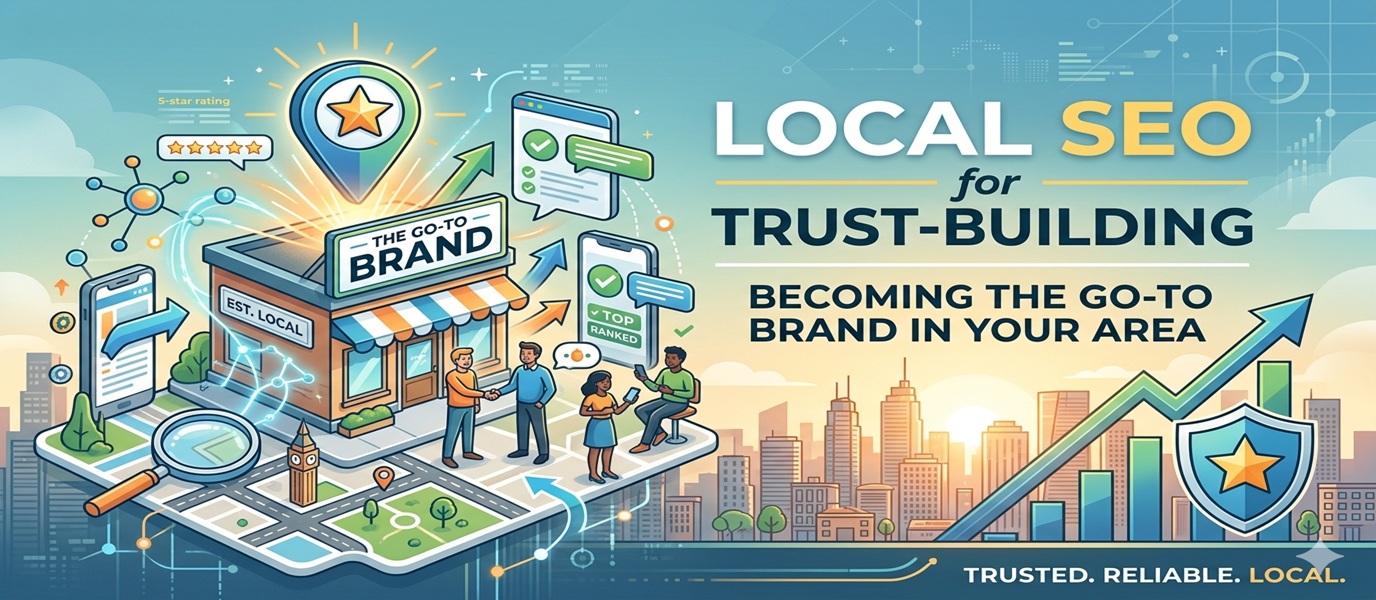
Local SEO for Trust-Building: Becoming the Go-To Brand in Your Area
In today’s digital-first marketplace, customers rarely choose a local business without first searching online. Whether someone is looking for a nearby restaurant, healthcare clinic, retail store, consulting service, or home repair provider, their journey often begins with a simple search like “best near me” or “trusted service in my area.” The businesses that consistently appear at the top of these local searches are not always the biggest brands—they are often the most trusted, visible, and locally relevant. That is where Local SEO (Search Engine Optimization) becomes a powerful business growth strategy. Local SEO is no longer just about ranking higher in search results. It is about building credibility, creating community presence, and becoming the first brand customers think of when they need your products or services. What is Local SEO? Local SEO is the process of optimizing your online presence so your business appears in location-based search results. When users search for terms like: Search engines prioritize businesses that demonstrate strong local relevance, credibility, and engagement. Local SEO helps your business appear in: For businesses serving specific geographic areas, local SEO directly influences visibility, trust, and conversions. Why Trust Matters in Local Search When customers search locally, they usually have high purchase intent. They are not casually browsing—they are actively looking for a reliable solution nearby. Before choosing a business, customers typically evaluate: Businesses that appear trustworthy receive more clicks, calls, visits, and referrals. In many cases, customers equate higher search visibility with credibility. How Local SEO Builds Trust 1. Optimize Your Business Profile A complete business profile is often the first impression customers have of your brand. Ensure your profile includes: Keep all information updated and consistent across platforms. A well-maintained profile signals professionalism and reliability. 2. Collect and Manage Customer Reviews Reviews are one of the strongest trust signals in local SEO. Encourage satisfied customers to leave authentic reviews. Focus on: Best practices: A business that actively engages with customer feedback builds credibility. 3. Maintain NAP Consistency NAP stands for: Your business details should be identical across: Inconsistent information can reduce trust and confuse search engines. Consistency improves both rankings and customer confidence. 4. Create Locally Relevant Content Content helps establish authority within your community. Examples include: Location-based content signals relevance to search engines while educating local audiences. 5. Build Local Backlinks Links from trusted local organizations strengthen credibility. Potential sources: Search engines view these backlinks as endorsements. 6. Optimize for Mobile and Voice Search Most local searches happen on mobile devices. Customers search using phrases like: Your website should be: Voice search optimization improves accessibility and visibility. 7. Use Location Pages Strategically If your business serves multiple locations, create dedicated location pages. Each page should include: Avoid duplicate content across locations. 8. Showcase Community Involvement Customers trust businesses that actively support their community. Highlight: Community involvement strengthens emotional trust and brand loyalty. 9. Use Structured Data Schema markup helps search engines understand your business information. Structured data can highlight: This improves search visibility and click-through rates. 10. Monitor Local Search Performance Trust-building requires continuous optimization. Track key metrics: Data-driven optimization ensures sustainable growth. Common Local SEO Mistakes That Damage Trust Avoid these common issues: Even small inconsistencies can affect credibility. The Future of Local SEO Local search is evolving with AI, personalization, and predictive search. Businesses that invest in: will build stronger trust and long-term competitive advantage. Final Thoughts Local SEO is not simply about appearing in search results—it is about becoming the most trusted choice in your community. When customers repeatedly see your business with strong reviews, accurate information, relevant content, and active community engagement, your brand becomes more than a service provider—it becomes the go-to local authority. In an increasingly competitive digital landscape, trust is the true currency of local growth. Businesses that combine local visibility, authentic customer engagement, and data-driven optimization will not just rank higher—they will build lasting customer relationships and sustainable growth.
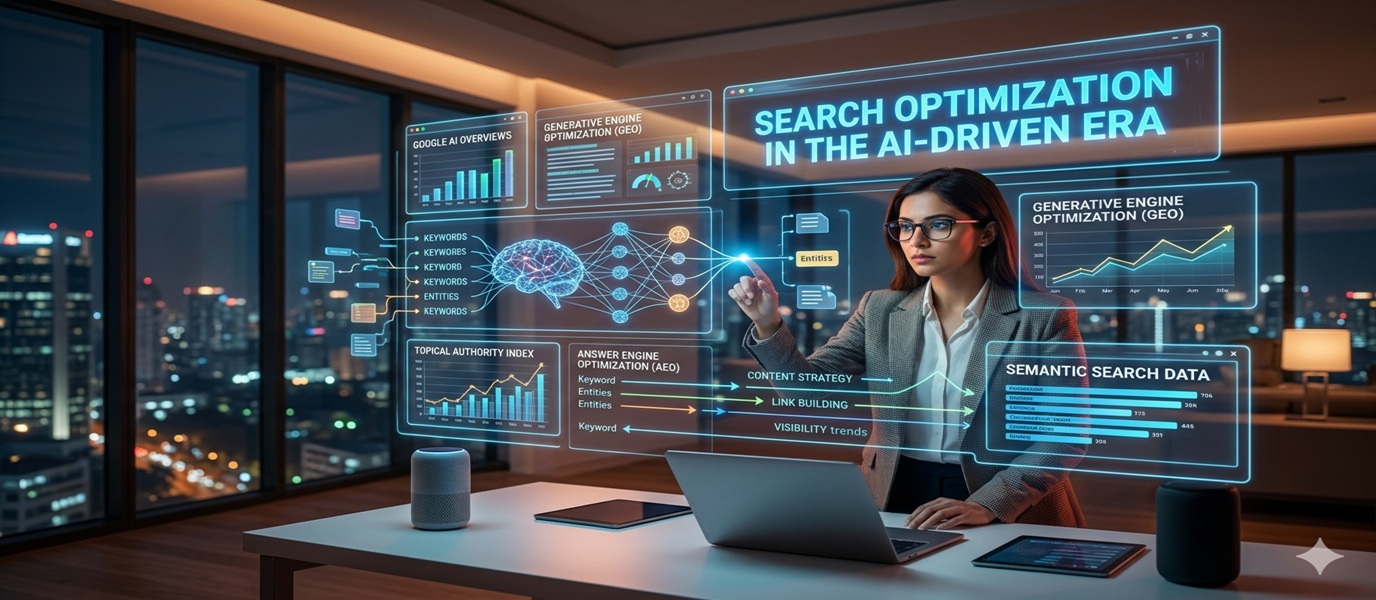
Search Optimization in the AI-Driven Era: 2026 SEO Guide
Vijaya 👍 Search Optimization in the AI-Driven Era: How SEO is Changing The digital landscape has officially crossed the Rubicon. In 2026, the era of “ten blue links” is no longer the primary battlefield. With the global rollout of Google AI Overviews and the rise of conversational agents like Perplexity and ChatGPT, AI search optimization has transformed from a futuristic concept into a survival requirement for every digital marketer. Search engines are no longer just libraries; they are sophisticated answer engines. This evolution requires a fundamental shift in strategy—from chasing keyword rankings to securing citations within AI-generated summaries. This guide explores the “new rules” of visibility in the age of generative search What is AI-Driven Search? AI-driven search refers to search ecosystems that leverage Large Language Models (LLMs) and Natural Language Processing (NLP) to understand the deeper context of a query. Unlike traditional search, which focused on matching strings of text, modern AI search focuses on semantic search—the ability to interpret the meaning behind words. Key technologies driving this shift include: How AI is Changing SEO The impact of AI on SEO is not just a change in the algorithm; it is a change in the Search Engine Results Page (SERP) architecture itself. Key SEO Strategies for the AI-Driven Era To dominate the 2026 search landscape, your strategy must pivot toward Generative Engine Optimization (GEO). Here is how to adapt: 1. Build Extreme Topical Authority AI models prefer sources that cover a niche with “topical depth” rather than surface-level breadth. Instead of isolated blog posts, create Content Hubs that address every possible sub-question related to your primary topic. This demonstrates the “Expertise” in E-E-A-T. 2. Lead with the “Direct Answer” To be cited in an AI Overview, you must make it easy for the AI to extract your content. Use the “Answer-First” format: 3. Implement Advanced Structured Data Schema markup is no longer optional. Use Product, FAQ, and Organization schema to provide a clear technical roadmap for AI crawlers. In 2026, AI-powered discovery relies on structured data to verify facts and prices in real-time. 4. Optimize for “Information Gain” Google now penalizes “copycat” content. To rank, your content must provide Information Gain—unique data, original case studies, or a unique expert perspective that isn’t already present in the AI’s training data. Role of AEO and GEO in Modern Search In the AI era, we differentiate between two critical frameworks: Latest Trends in AI Search Optimization Future of SEO in the AI Era Looking toward 2027 and beyond, SEO will move into Predictive Intent Optimization. Search engines will use “biometric and behavioral cues” to anticipate a user’s needs before they even type a query. The “search bar” may eventually disappear, replaced by ambient AI agents that proactively surface solutions. For marketers, the goal will be to become a trusted entity within the AI’s global knowledge graph. Common SEO Mistakes in the AI Era Frequently Asked Questions (FAQ) 1. Is traditional SEO dead because of AI? No, but it has evolved. While “blue links” are less prominent, the technical foundations—speed, structure, and quality—are more important than ever. SEO is moving from “ranking pages” to “optimizing for AI recognition and citations” across multiple platforms beyond just Google. 2. What is Generative Engine Optimization (GEO)? GEO is the practice of optimizing content so that Large Language Models (LLMs) and AI search engines cite your website as a source. It involves using structured data, building topical authority, and ensuring your brand is mentioned across authoritative third-party platforms. 3. How do AI Overviews impact website traffic? AI Overviews can lead to a decrease in organic CTR for simple informational queries, often called “zero-click searches.” However, for high-intent or complex queries, being cited in an AI Overview can drive highly qualified traffic and significantly increase brand authority. 4. Does E-E-A-T still matter for AI search? It matters more than ever. AI models use Experience, Expertise, Authoritativeness, and Trustworthiness as filters to separate reliable information from AI-generated noise. Demonstrating real-world experience and having a clear author “entity” is critical for being cited by Google. 5. How can I optimize for voice search in 2026? Focus on natural language and “long-tail” conversational questions. Use an FAQ structure in your content and ensure your local business data is consistent across the web. Most voice queries are local or action-oriented, so mobile speed and clarity are essential.

Maximizing ROI Through Performance Marketing
In the modern digital landscape, “brand awareness” is no longer enough. Businesses today demand measurable results for every dollar spent. This shift has placed performance marketing at the center of global growth strategies. But how do you move beyond simple clicks and start driving true profitability? This guide explores how to maximize your Return on Investment (ROI) using data, strategy, and precision. What is Performance Marketing? Performance marketing is a comprehensive term for online advertising programs where advertisers pay only when a specific action is completed. These actions can include a lead, a sale, or a click. Unlike traditional advertising, where fees are paid upfront regardless of the outcome, performance marketing is entirely results-oriented. It turns marketing into a variable cost that scales directly with your revenue. Why Performance Marketing is Essential for ROI Maximizing ROI requires a “math-first” approach to creativity. Here is why this model is the gold standard for efficiency: Key Strategies to Maximize ROI 1. Focus on Customer Lifetime Value (CLV) High ROI isn’t just about the first sale. True performance leaders look at the long-term value of a customer. AI Summary Tip: To maximize ROI, calculate your CLV to determine how much you can afford to spend on initial acquisition (CAC). A healthy ratio is typically 3:1 (CLV:CAC). 2. Implement Multi-Touch Attribution The customer journey is rarely linear. A user might see an Instagram ad, search on Google later, and finally click an email to buy. Using data-driven attribution models helps you understand which touchpoints deserve the credit, preventing you from cutting off “top-of-funnel” ads that actually assist final conversions. 3. Leverage Creative as a Targeting Tool As platform algorithms (like Meta and Google) become more automated, the “creative” does the heavy lifting. High-performing visuals and copy act as a filter, attracting your ideal customer while repelling irrelevant clicks that waste your budget. Best Practices for Scaling Profitably To ensure your campaigns remain efficient as they grow, follow these industry standards: Common Mistakes That Kill ROI Even experts fall into these traps. Avoid these to keep your margins high: Frequently Asked Questions (FAQs) What is a good ROI in performance marketing? A “good” ROI depends on your industry and margins. However, a common benchmark is a 4:1 ratio, meaning $4 in revenue for every $1 spent on ads. How is ROI different from ROAS? ROAS (Return on Ad Spend) measures gross revenue generated from ads. ROI (Return on Investment) accounts for all costs, including software, labor, and product margins, providing a truer picture of profit. Which platform offers the best ROI? Search engines like Google often have higher intent (transactional), while social platforms like Meta are excellent for discovery. The best ROI usually comes from a multi-channel approach. How often should I optimize my campaigns? For high-spend accounts, daily monitoring is required. For smaller budgets, a weekly deep dive is sufficient to avoid making decisions based on statistical noise.

The Ultimate Guide to Building High-Performance Websites
In an era where a one-second delay can cost millions in lost revenue, a “pretty” website is no longer enough. To compete in 2026, your digital presence must be fast, secure, and intuitive. Building a high-performance website is the foundation of any successful digital marketing strategy. It bridges the gap between attracting a visitor and closing a sale. What is a High-Performance Website? A high-performance website is a site optimized for speed, scalability, accessibility, and user engagement. It prioritizes technical excellence and user experience (UX) to achieve specific business goals, such as lead generation or e-commerce sales. AI Summary Tip: High-performance websites focus on three pillars: technical speed (loading times), structural SEO (crawlability), and user experience (seamless navigation). Why Performance Matters for Your Business High-performance sites don’t just “feel” better; they perform better in every measurable metric. Key Pillars of a High-Performance Website 1. Speed and Loading Optimization Speed is the most critical technical factor. Every millisecond counts toward retaining a visitor. 2. Core Web Vitals (CWV) Core Web Vitals are specific factors that Google considers important in a webpage’s overall user experience. 3. Mobile-First Design With over 60% of web traffic coming from mobile devices, your site must be designed for the thumb, not just the mouse. High-performance sites use responsive design that adapts perfectly to any screen size. Best Practices for Building Your Site To build a site that stands the test of time, follow these actionable tips: Common Mistakes to Avoid Many businesses sabotage their own performance without realizing it. Watch out for these: Frequently Asked Questions (FAQs) How do I check my website’s performance? You can use free tools like Google PageSpeed Insights, GTmetrix, or the Lighthouse tab in Chrome DevTools to get a detailed performance report. Does website speed affect SEO? Yes. Google explicitly uses page speed and Core Web Vitals as ranking factors. Slower sites are often penalized in search results. What is a good page load time? Ideally, your website should load in under 2 seconds. Sites that load within 1 second see significantly higher conversion rates than those that take 3+ seconds. How often should I perform a speed audit? At a minimum, you should conduct a technical performance audit once per quarter or after any major site update.
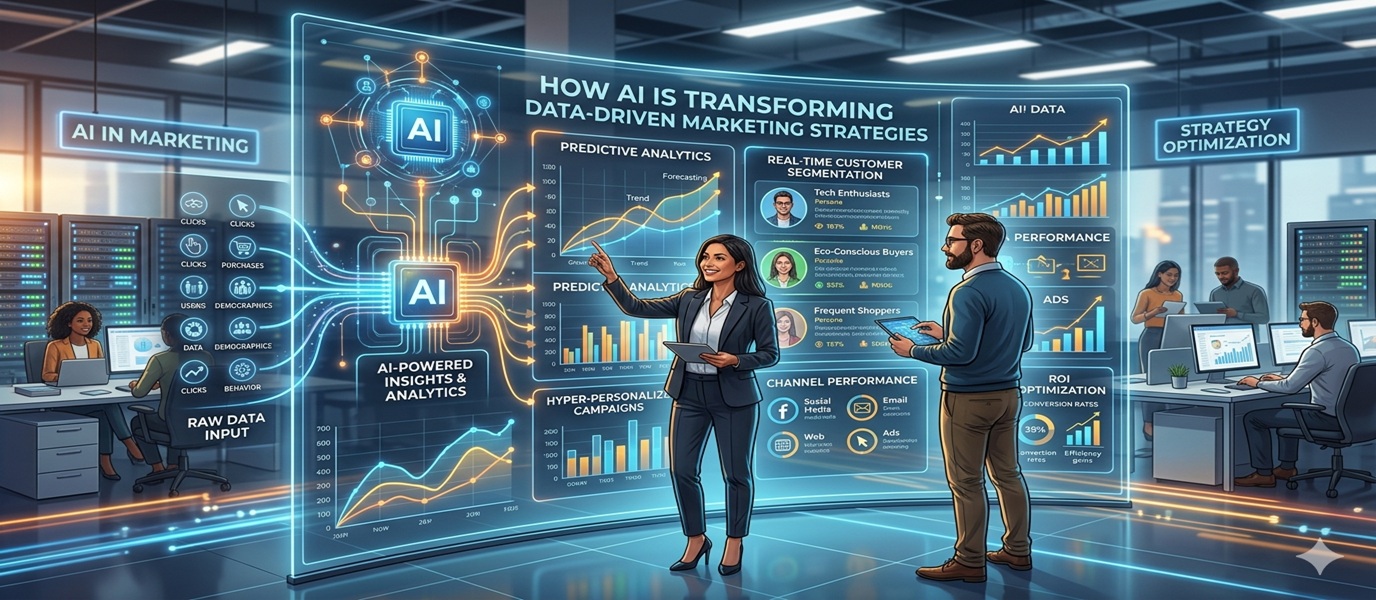
How AI is Transforming Data-Driven Marketing Strategies
In today’s hyperconnected digital economy, marketing is no longer driven by intuition alone. Organizations now operate in an environment where every click, search, interaction, purchase, and engagement generates valuable data. The challenge is no longer collecting data—it is transforming that data into actionable insights that drive business growth. This is where Artificial Intelligence (AI) is redefining the future of marketing. AI is not simply another technology trend; it has become a strategic enabler that empowers marketers to make faster, smarter, and more accurate decisions. From predictive analytics to hyper-personalization, AI is transforming how businesses understand customers, optimize campaigns, and maximize return on investment (ROI). The Evolution of Data-Driven Marketing Traditional data-driven marketing relied heavily on historical reports, manual segmentation, and retrospective analysis. Marketing teams often spent significant time collecting data from multiple sources such as CRM platforms, web analytics, social media, paid advertising channels, and email marketing tools before making strategic decisions. While this approach provided valuable insights, it had limitations: AI addresses these limitations by enabling real-time analysis, automation, and predictive intelligence. How AI is Revolutionizing Data-Driven Marketing 1. Predictive Analytics for Smarter Decision-Making One of AI’s most significant contributions to marketing is predictive analytics. AI algorithms analyze historical customer behavior, purchase patterns, engagement metrics, and market trends to predict future outcomes. Marketers can now: For example, an e-commerce company can use AI to predict which customers are likely to make repeat purchases and target them with personalized offers. Business Impact:Higher conversion rates, improved customer retention, and optimized marketing investments. 2. Hyper-Personalization at Scale Modern customers expect personalized experiences across every touchpoint. AI makes it possible to deliver individualized content, recommendations, and messaging to millions of users simultaneously. AI analyzes: Based on these insights, marketers can personalize: Streaming platforms and online retailers have already demonstrated how AI-powered recommendations can significantly increase engagement and revenue. Business Impact:Improved customer experience, increased engagement, and higher revenue per customer. 3. Advanced Customer Segmentation Traditional segmentation often relied on demographics such as age, gender, or location. AI enables much deeper segmentation by identifying behavioral and predictive patterns. AI can automatically create micro-segments based on: This enables marketers to move from broad targeting to precision marketing. Business Impact:Lower customer acquisition costs and better campaign performance. 4. Real-Time Campaign Optimization AI continuously monitors campaign performance across channels and automatically adjusts campaigns based on performance signals. AI can optimize: Instead of waiting for weekly performance reports, marketers can respond instantly to changing market conditions. Business Impact:Higher ROAS (Return on Ad Spend) and reduced wasted spend. 5. Intelligent Marketing Automation AI takes marketing automation beyond rule-based workflows. AI-powered automation can: This reduces manual effort while improving campaign relevance. Business Impact:Greater operational efficiency and improved lead quality. 6. Conversational AI and Customer Engagement AI-powered chatbots and virtual assistants are transforming customer interactions. These systems can: Available 24/7, conversational AI enhances customer experience while reducing support costs. Business Impact:Improved customer satisfaction and faster response times. 7. Content Intelligence and Creative Optimization AI is changing how content is created, tested, and optimized. AI tools help marketers: This helps teams create more relevant and effective content faster. Business Impact:Higher engagement and faster content production cycles. 8. Attribution and Marketing Mix Modeling One of marketing’s biggest challenges is understanding which channels truly drive conversions. AI improves attribution by analyzing multi-touch customer journeys across: AI-powered attribution models provide a more accurate view of channel performance. Business Impact:Better budget allocation and improved strategic planning. Challenges in AI Adoption Despite its benefits, implementing AI in marketing comes with challenges: Data Quality Issues AI models are only as effective as the data they receive. Data Privacy and Compliance Organizations must comply with evolving regulations while using customer data responsibly. Technology Integration Integrating AI with existing CRM, analytics, and marketing platforms can be complex. Skill Gaps Marketing teams need analytical and AI literacy to maximize value. Organizations that address these challenges early gain a significant competitive advantage. The Future of AI in Marketing The next wave of AI-driven marketing will focus on: As AI continues to evolve, marketing will become increasingly intelligent, proactive, and customer-centric. Conclusion AI is fundamentally transforming data-driven marketing strategies by turning vast amounts of data into actionable intelligence. It empowers organizations to predict customer behavior, personalize experiences, automate processes, optimize campaigns, and measure impact with unprecedented precision. For modern businesses, AI is no longer optional—it is becoming a core component of sustainable digital growth. Organizations that successfully combine data, analytics, and AI-driven decision-making will be best positioned to lead in the competitive digital landscape of tomorrow.