
Vijaya 👍
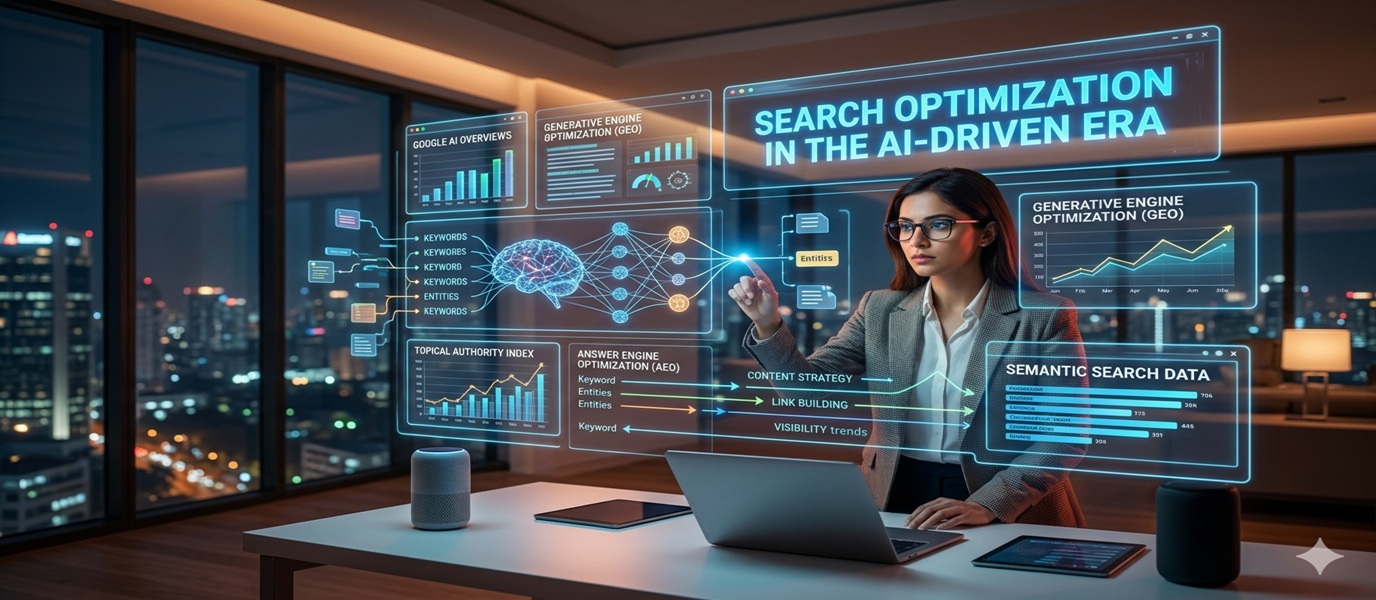
Search Optimization in the AI-Driven Era: How SEO is Changing
The digital landscape has officially crossed the Rubicon. In 2026, the era of “ten blue links” is no longer the primary battlefield. With the global rollout of Google AI Overviews and the rise of conversational agents like Perplexity and ChatGPT, AI search optimization has transformed from a futuristic concept into a survival requirement for every digital marketer.
Search engines are no longer just libraries; they are sophisticated answer engines. This evolution requires a fundamental shift in strategy—from chasing keyword rankings to securing citations within AI-generated summaries. This guide explores the “new rules” of visibility in the age of generative search
What is AI-Driven Search?
AI-driven search refers to search ecosystems that leverage Large Language Models (LLMs) and Natural Language Processing (NLP) to understand the deeper context of a query. Unlike traditional search, which focused on matching strings of text, modern AI search focuses on semantic search—the ability to interpret the meaning behind words.
Key technologies driving this shift include:
- Machine Learning (ML): Predictive algorithms that analyze user behavior to deliver personalized results.
- Conversational Search: The ability for users to engage in a dialogue with search engines, asking follow-up questions that maintain context.
- Generative Summarization: Systems like Google’s Andromeda framework that synthesize information from dozens of sources into a single, cohesive answer.
How AI is Changing SEO
The impact of AI on SEO is not just a change in the algorithm; it is a change in the Search Engine Results Page (SERP) architecture itself.
- The Surge of Zero-Click Searches: Recent studies show that over 60% of informational queries now end in a “zero-click” result. Users get their answers directly from an AI Overview without ever visiting a website.
- Agentic Search & “Fan-Out” Queries: When a user asks a complex question, AI engines now perform “fan-out” searches—executing 5–10 sub-queries simultaneously to build a comprehensive answer.
- Entity-First Indexing: Google now prioritizes entities (people, places, brands) and their relationships over simple keyword density.
- Voice and Multimodal Shifts: With the rise of AI wearables and glasses, search is moving beyond the screen. Visual and voice-based queries are now the default for local and real-time discovery.
Key SEO Strategies for the AI-Driven Era
To dominate the 2026 search landscape, your strategy must pivot toward Generative Engine Optimization (GEO). Here is how to adapt:
1. Build Extreme Topical Authority
AI models prefer sources that cover a niche with “topical depth” rather than surface-level breadth. Instead of isolated blog posts, create Content Hubs that address every possible sub-question related to your primary topic. This demonstrates the “Expertise” in E-E-A-T.
2. Lead with the “Direct Answer”
To be cited in an AI Overview, you must make it easy for the AI to extract your content. Use the “Answer-First” format:
- Start your article with a concise 40–60 word summary of the main topic.
- Use clear, declarative sentences (e.g., “The best way to optimize for AI is…”) to provide “snippet-friendly” passages.
3. Implement Advanced Structured Data
Schema markup is no longer optional. Use Product, FAQ, and Organization schema to provide a clear technical roadmap for AI crawlers. In 2026, AI-powered discovery relies on structured data to verify facts and prices in real-time.
4. Optimize for “Information Gain”
Google now penalizes “copycat” content. To rank, your content must provide Information Gain—unique data, original case studies, or a unique expert perspective that isn’t already present in the AI’s training data.
Role of AEO and GEO in Modern Search
In the AI era, we differentiate between two critical frameworks:
- Answer Engine Optimization (AEO): The process of optimizing content to be the definitive answer for voice assistants and “featured snippets.” It focuses on brevity and clarity.
- Generative Engine Optimization (GEO): A broader strategy designed to ensure your brand is cited by LLMs (like Perplexity or Gemini). GEO focuses on citation-worthiness, ensuring your brand is mentioned across high-authority “seed sites” like Reddit, Wikipedia, and niche industry forums.
Latest Trends in AI Search Optimization
- Hyper-Local AI Discovery: AI assistants now prioritize “proximity + reputation.” Maintaining a 4.5+ star rating on local platforms is now a primary SEO signal for brick-and-mortar businesses.
- Google Search Generative Experience (SGE): Now fully integrated, SGE results occupy the “Position 0” spot for nearly 80% of B2B tech and education queries.
- Multimodal Search: Users are increasingly using “Circle to Search” or taking photos to find products. Optimizing image metadata and video transcripts is now a core SEO pillar.
Future of SEO in the AI Era
Looking toward 2027 and beyond, SEO will move into Predictive Intent Optimization. Search engines will use “biometric and behavioral cues” to anticipate a user’s needs before they even type a query. The “search bar” may eventually disappear, replaced by ambient AI agents that proactively surface solutions. For marketers, the goal will be to become a trusted entity within the AI’s global knowledge graph.
Common SEO Mistakes in the AI Era
- Over-Reliance on AI Writing: Publishing unedited AI content leads to “hallucinations” and a lack of original insight, which modern algorithms easily detect and demote.
- Neglecting Brand Mentions: If your brand isn’t talked about on third-party sites, AI models will lack the “social proof” needed to cite you as an authority.
- Ignoring Technical Speed: With AI crawlers hitting sites more frequently to fetch real-time data, a Server Response Time above 500ms can get your site skipped.
- Keyword Stuffing: Using the same phrase repeatedly is a signal of low-quality content. Focus instead on semantic clusters.
Frequently Asked Questions (FAQ)
1. Is traditional SEO dead because of AI?
No, but it has evolved. While “blue links” are less prominent, the technical foundations—speed, structure, and quality—are more important than ever. SEO is moving from “ranking pages” to “optimizing for AI recognition and citations” across multiple platforms beyond just Google.
2. What is Generative Engine Optimization (GEO)?
GEO is the practice of optimizing content so that Large Language Models (LLMs) and AI search engines cite your website as a source. It involves using structured data, building topical authority, and ensuring your brand is mentioned across authoritative third-party platforms.
3. How do AI Overviews impact website traffic?
AI Overviews can lead to a decrease in organic CTR for simple informational queries, often called “zero-click searches.” However, for high-intent or complex queries, being cited in an AI Overview can drive highly qualified traffic and significantly increase brand authority.
4. Does E-E-A-T still matter for AI search?
It matters more than ever. AI models use Experience, Expertise, Authoritativeness, and Trustworthiness as filters to separate reliable information from AI-generated noise. Demonstrating real-world experience and having a clear author “entity” is critical for being cited by Google.
5. How can I optimize for voice search in 2026?
Focus on natural language and “long-tail” conversational questions. Use an FAQ structure in your content and ensure your local business data is consistent across the web. Most voice queries are local or action-oriented, so mobile speed and clarity are essential.